-
 Learn More
Personalized Gifts
Create a memorable keepsake with our custom laser engraving service.

 Sale
SaleCreative Crafthouse
Martin's Menace Small | Stewart Coffin #217 Wood Puzzle
Sale price$13.35 Regular price $15.75


 Sale
SaleCreative Crafthouse
Cruiser - 4-Piece Wooden Brain Teaser for Teens and Adults
Sale price$14.00 Regular price $16.49


Frequently Asked Questions
Who is Stewart Coffin and why is his work so collected?
Who is Stewart Coffin and why is his work so collected?
Stewart Coffin is an American puzzle designer widely regarded as one of the most important figures in mechanical puzzle design. He trained as an electrical engineer at the University of Massachusetts at Amherst (class of 1953), worked at MIT's Lincoln Laboratory through the late 1950s, then left electronics in 1964 for canoe and kayak building before turning full-time to puzzles in 1968. He has designed more than 400 original mechanical puzzles, many of them interlocking polyhedrons and dissection puzzles that have become foundational works in the field. Coffin calls his work "AP-ART," his own term for "the sculptural art that comes apart." He received the Sam Loyd Award in 2000 and the Nob Yoshigahara Lifetime Achievement Award in 2006, two of the highest honors in the mechanical-puzzle world. His designs are studied, reproduced, collected, and traded by serious puzzlers around the world.
What does "with Coffin's permission" mean?
What does "with Coffin's permission" mean?
It means exactly what it says. Creative Crafthouse reproduces Stewart Coffin's designs with his direct permission. The agreement to reproduce these specific designs was made directly between Stewart and Dave Janelle, our founder. We honor his original design intent, and we attribute every Coffin design to him by name, and by design number where one applies. If you ever see a "Stewart Coffin" puzzle on a mass-market site without an attribution to him on the listing, that is a warning sign. Coffin's designs are his work. They get his name on them, every time.
Which Coffin design should I start with? Which is the hardest?
Which Coffin design should I start with? Which is the hardest?
If you are new to Stewart Coffin and want a starting point, the Cruiser is the most accessible. Four pieces, a clear coffee-table footprint, intermediate difficulty, and a satisfying "aha" moment. From there, work up through the Outback (#222), the Rhombic Blocks (#122), and the Half Hour Cube (a 1975 Coffin design, 3 x 3 x 3 cube). For the hardest, the Martin's Menace Large (#217) is the one. Coffin originally called it "Four Fit" and renamed it after Martin Gardner, the founder of modern recreational mathematics, spent a full week trying to solve it without success. Gardner later called Martin's Menace "the finest dissection puzzle of all time." Four pieces. One frame. We do not include the solution. If you would rather have a very hard challenge with a safety net, the Five Fit Large (#177A) comes with a printed solution inside the box.
What is the design number system (#122, #177A, #217, #222)?
What is the design number system (#122, #177A, #217, #222)?
Coffin numbered every puzzle he designed, in the order he designed it, starting in 1968. The numbering is his own meticulous record-keeping habit, captured publicly in his book "Geometric Puzzle Design" (AK Peters / Taylor and Francis, 2006) and in his AP-ART compendium. Lower numbers come from his earliest work; higher numbers from later decades. Letter suffixes (the "A" in #177A) mark a variant of an existing design. A handful of design numbers we carry, with the Coffin name attached: #122 Rhombic Blocks, nine-piece geometric, multiple solutions. #177A Five Fit, five pieces packing into a frame, expert difficulty. #217 Martin's Menace, four pieces, no solution provided. #222 Outback, five pieces including a maple rectangle. #260 Cracked Egg, six dissection pieces fitting into an oval cutout. A few of the Coffin pieces in our line are referenced by his original name rather than a number on the listing (Half Hour Cube, Convolution Blockhead, Interlock 4). Coffin himself catalogued well over 400 designs across his career, and the numbering is the most authoritative way to identify a specific piece you have read about in a puzzle book or seen in a museum collection.
What wood do you use, and how are these finished?
What wood do you use, and how are these finished?
Materials vary by design. Across the Coffin line we use wood pieces such as maple and cherry, plus floorboard stock and wood-finished MDF where a design calls for them. Most of these puzzles are precision laser-cut in our Hudson, Florida workshop, hand-finished, and inspected before they ship. The fit and feel are consistent piece to piece because the pieces are cut to tight tolerances, and the wood pieces carry natural grain variation.
Do these ship with solutions, or do I have to figure them out?
Do these ship with solutions, or do I have to figure them out?
Every Coffin puzzle in our collection ships with a printed solution tucked inside, with one deliberate exception: Martin's Menace (#217), in both the Small and Large sizes, ships UNSOLVED and WITHOUT a printed solution. That is intentional. If you really need it, email puzzles@creativecrafthouse.com and we will send the solution. Every other Coffin in this collection (the Cruiser, the Five Fit, the Outback, the Half Hour Cube, the Rhombic Blocks, the Convolution Blockhead, the Interlock 4, the Cracked Egg) ships unsolved with the printed solution inside the box, so you can put it down for a while and pick it back up later without the puzzle becoming a piece of unfinished furniture on your desk.
Are these gifts, or are they collector items? Who actually buys them?
Are these gifts, or are they collector items? Who actually buys them?
Both, depending on who you are buying for. Stewart Coffin's work is widely collected by mechanical-puzzle enthusiasts, math teachers, engineers, and hobbyist puzzle clubs. At the same time, these are wood objects that look at home on a coffee table, a desk, or a bookshelf, and they hold up to being picked up, handled, and disassembled by adult guests at a dinner party. They make good gifts for engineers, woodworkers, math and physics fans, hobbyist puzzlers, and grandparents who want a piece on the table when grandkids visit. Coffin's name carries weight inside the puzzle community, which is why a Coffin reproduction with the design number attached on the product page reads as a serious gift to anyone who knows the field.
Are there Coffin designs you do not reproduce?
Are there Coffin designs you do not reproduce?
Yes. Stewart Coffin designed more than 400 original puzzles over his career. We reproduce a curated set of twelve. Our selection prioritizes the designs we believe represent Coffin's range (a dissection puzzle like Cracked Egg, a packing puzzle like Five Fit, an interlocking cube like Convolution Blockhead, the famously hard Martin's Menace) and the ones that work well as a hand-finished wooden object at our shop scale and pricing. Coffin's full catalogue includes large polyhedral sculptures, miniature mathematical curiosities, and limited-run pieces that we are not set up to reproduce. If you are looking for a specific Coffin design number that is not in our collection, email puzzles@creativecrafthouse.com. We cannot always say yes, but we are happy to point you toward another maker or another design in our line that has a similar flavor.
Can a Coffin reproduction be engraved, and should it be?
Can a Coffin reproduction be engraved, and should it be?
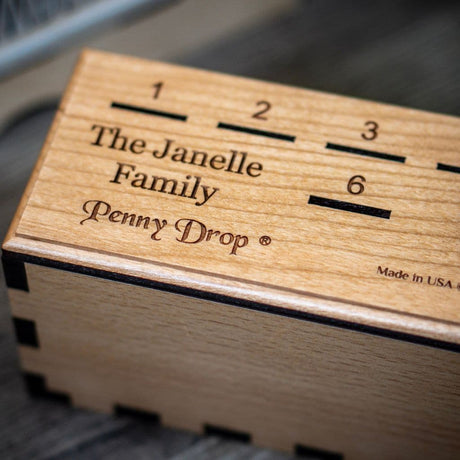
Yes. Every piece in the collection can be laser-engraved with up to 45 characters. The engraving lands on the frame of the puzzle by default so the puzzle pieces themselves are not altered and the original Coffin design plays as intended. If you want the engraving on one of the individual puzzle pieces (a name on a maple block, a dedication on an interior face, etc.), email puzzles@creativecrafthouse.com and we will work it out with you directly. For a company or institutional logo, or for engraving on multiple sides of the frame, email puzzles@creativecrafthouse.com or request a quote for custom work for pricing. See our laser engraving page for fonts and examples. One note worth flagging: if the gift is for a serious Stewart Coffin collector who is going to want the cleanest possible reproduction with no extra engraving on the base, leave it unengraved. The piece without engraving is the canonical Coffin reproduction. The engraved version is the personalized gift. Both are valid; pick the right one for the recipient.
How do I know it is a real Coffin reproduction? Returns?
How do I know it is a real Coffin reproduction? Returns?
Every Coffin puzzle in this collection is made by Creative Crafthouse with Coffin's permission and attributed to him by name and (where applicable) by design number on the product page. Most are made in our Hudson, Florida workshop. No missing attribution. If you ever see a "Stewart Coffin" puzzle on another site without a clear Coffin attribution and without a maker visible behind it, that is a warning sign worth a question. Returns: full terms live on our shipping and return policies page (linked from the footer of every page). The short version: request a return within 30 days of receiving your order, and send it back in the same condition you received it; once your return is accepted, we send you a free return shipping label. Personalized and custom items cannot be returned. If we make a mistake on your order, we'll replace or refund it at no cost. If an engraving or address mistake comes from information you supplied, we do not refund the item or shipping costs. If a piece arrives damaged or defective, contact us right away and we will evaluate it and make it right. Email sales@creativecrafthouse.com to start any return or replacement, and Deb on our team will handle it personally.